
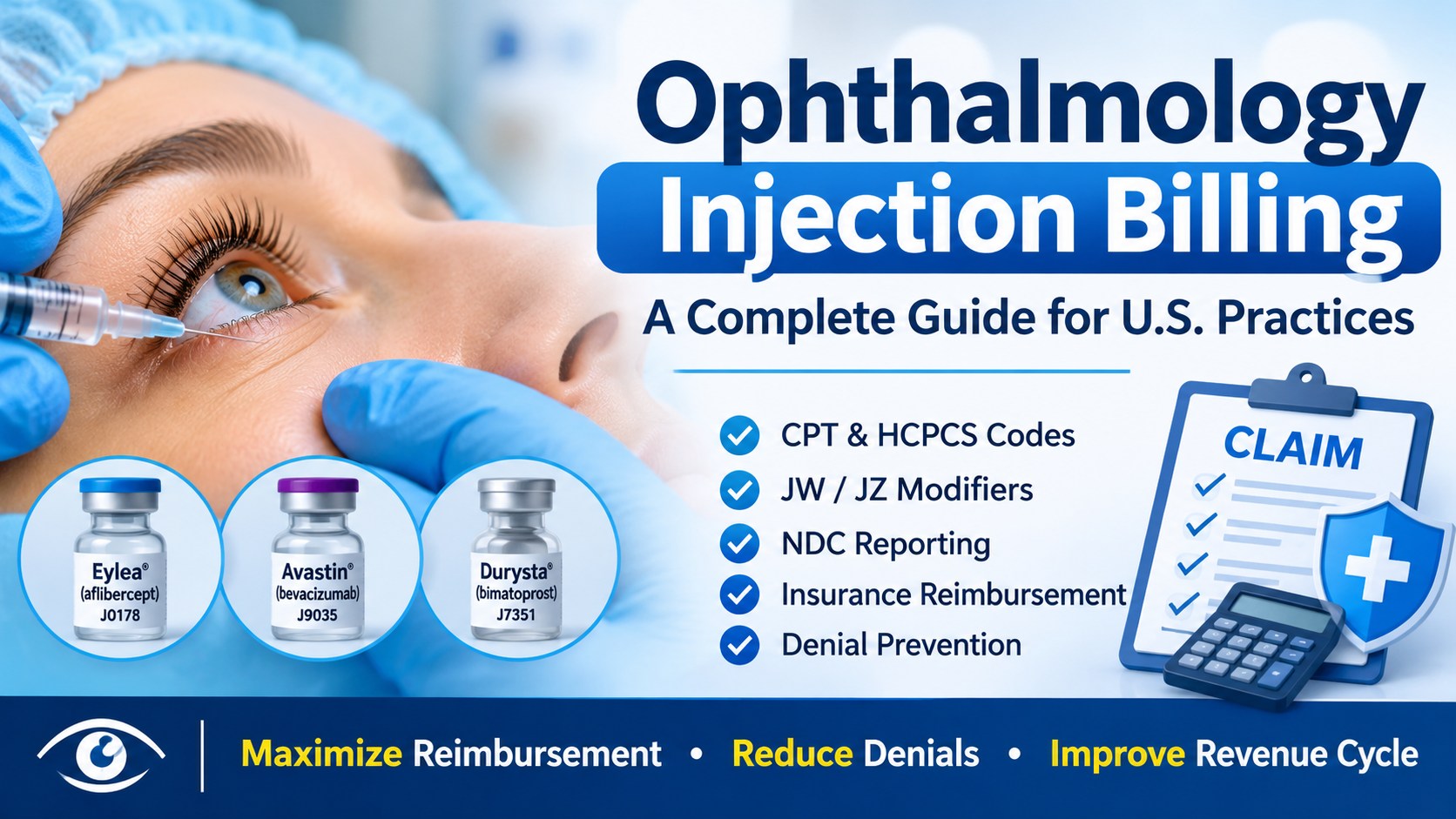
Ophthalmology Injection Billing: A Complete Guide to Billing Injections to Insurance Companies in the USA
Understanding CPT Codes, HCPCS J-Codes, Modifiers, Documentation, and Insurance Reimbursement
Ophthalmology practices frequently perform specialized injections to treat retinal diseases, macular degeneration, diabetic retinopathy, glaucoma, and other eye conditions. Accurate billing helps practices reduce avoidable denials and support timely reimbursement.
What Is Ophthalmology Injection Billing?
Ophthalmology injection billing involves submitting insurance claims for both the injection procedure and the medication administered to the patient.
Depending on the treatment, an ophthalmologist may perform:
- Intravitreal injections
- Anterior chamber injections
- Subconjunctival injections
- Suprachoroidal injections
- Other therapeutic ophthalmic injections
Procedure billing: Report the appropriate CPT code for the injection procedure.
Medication billing: Report the appropriate HCPCS J-code or other applicable drug code, along with the correct number of billing units.
Both components must be supported by medical documentation and applicable payer guidelines.
Common Ophthalmology Injection CPT Codes
The following CPT codes are commonly relevant to ophthalmic injection procedures.
| CPT code | Description |
|---|---|
| 67028 | Intravitreal injection of a pharmacologic agent |
| 66030 | Injection of medication into the anterior chamber |
| 66020 | Injection of air or liquid into the anterior chamber |
| 67516 | Suprachoroidal injection of a pharmacologic agent |
| 68200 | Subconjunctival injection |
Common Injectable Drugs and HCPCS Codes
Ophthalmology practices administer several medications for retinal and other eye conditions. Examples include:
| Medication | Common HCPCS code |
|---|---|
| Eylea (aflibercept) | J0178 |
| Avastin (bevacizumab) | J9035 |
| Lucentis (ranibizumab) | J2778 |
| Vabysmo (faricimab-svoa) | J2777 |
| Ozurdex (dexamethasone implant) | J7312 |
| Durysta (bimatoprost implant) | J7351 |
| Beovu (brolucizumab-dbll) | J0179 |
The correct code and billing units should always be verified against the current HCPCS code set, drug labeling, payer policy, and date of service. Requirements may differ depending on formulation, dosage, and packaging.
How to Bill Intravitreal Injections to Insurance
Intravitreal injection billing generally involves reporting the procedure and the medication separately when both are separately payable.
CPT 67028 – Intravitreal injection of a pharmacologic agent.
Report the appropriate HCPCS code, correct billing units based on the code descriptor, and applicable laterality or other modifiers required by the payer.
Report the appropriate ICD-10-CM diagnosis supporting medical necessity and link it to the applicable procedure and medication lines.
For Medicare, bilateral procedure billing and drug billing must follow the applicable Medicare Administrative Contractor (MAC) instructions.
Understanding RT, LT, and 50 Modifiers
Laterality is an important part of ophthalmology injection billing.
| Modifier | Meaning | Example |
|---|---|---|
| RT | Right eye | 67028-RT |
| LT | Left eye | 67028-LT |
| 50 | Bilateral procedure, when permitted | 67028-50 |
Do not automatically apply modifier 50 to every bilateral claim. Medicare and commercial insurance companies may have different billing instructions. Drug lines must also follow the applicable payer's drug billing and laterality requirements.
JW and JZ Modifiers for Drug Wastage
Drug amount discarded
Identifies the amount of eligible medication discarded and not administered to any patient. Administered and discarded amounts may need to be reported on separate claim lines, following payer requirements.
No drug amount discarded
Indicates that no drug amount was discarded. For applicable Medicare Part B single-dose container claims, JZ is required when there is no discarded amount.
- Do not use JW when no drug was discarded.
- Do not use JZ when drug wastage occurred.
- Document administered and discarded quantities accurately.
- Do not bill discarded amounts from multi-dose vials under the Medicare discarded-drug policy.
- Follow the applicable payer's modifier requirements.
NDC Reporting for Injectable Medications
Some insurance companies require National Drug Code (NDC) information when submitting claims for injectable medications. NDC reporting may include:
- 11-digit NDC number
- NDC unit of measurement
- NDC quantity
- Appropriate NDC qualifier
- Medication name and dosage, when required
For example, an NDC may be reported in the 5-4-2 format with the N4 qualifier. Verify the actual product NDC and the payer's electronic claim requirements before submission.
Medical Documentation Requirements
Proper documentation is essential for successful ophthalmology injection reimbursement. The medical record should support the medical necessity of the procedure and medication.
- Patient demographics and insurance information
- Relevant ophthalmic examination findings
- Diagnosis and medical necessity
- Medication name and dosage
- Eye treated (right, left, or both)
- Route of administration
- Procedure date
- Medication details, including NDC when required
- Administered and discarded amounts, when applicable
- Physician's procedure documentation
Incomplete documentation can result in insurance denials, medical record requests, and payment delays.
Prior Authorization and Insurance Verification
Before administering expensive ophthalmic medications, practices should verify insurance coverage and authorization requirements.
- Confirm active insurance coverage.
- Check whether the medication is covered under the patient's medical or pharmacy benefit.
- Verify the appropriate medication and dosage.
- Check prior authorization requirements.
- Confirm site-of-service restrictions.
- Verify specialty drug requirements.
- Check patient coinsurance and deductible.
- Confirm whether the medication must be purchased through an approved specialty pharmacy.
Medicare Advantage plans and commercial insurance companies may have different authorization and reimbursement requirements.
Common Ophthalmology Injection Billing Denials
| Denial issue | Possible solution |
|---|---|
| Incorrect HCPCS drug code | Verify the correct drug code. |
| Incorrect units | Recalculate units using the code descriptor. |
| Missing or incorrect modifier | Review payer-specific modifier guidelines. |
| Incorrect JW/JZ usage | Verify drug wastage documentation. |
| Missing prior authorization | Review authorization requirements. |
| Invalid NDC information | Correct NDC and quantity details. |
| Medical necessity denial | Review diagnosis and supporting records. |
| Duplicate claim denial | Check original claim and corrected claim history. |
| Incorrect laterality | Verify the eye treated. |
| Missing documentation | Submit supporting medical records when requested. |
A strong denial management process helps ophthalmology practices identify recurring billing issues and improve reimbursement.
How Professional Medical Billing Helps Ophthalmology Practices
Ophthalmology injection billing requires specialized knowledge of procedure coding, drug billing, insurance policies, and reimbursement guidelines.
A dedicated ophthalmology medical billing team can help practices with:
- Charge entry and claim submission
- CPT and HCPCS code verification
- Drug unit calculation
- Modifier review
- NDC reporting
- Insurance eligibility verification
- Prior authorization follow-up
- Payment posting
- Denial management
- Corrected claims and appeals
- Accounts receivable follow-up
- Monthly revenue cycle reporting
Professional billing support can reduce administrative workload and help ophthalmologists focus more on patient care.
Final Thoughts
Ophthalmology injection billing is more complex than simply submitting a procedure code and medication code. Successful reimbursement depends on accurate coding, correct billing units, appropriate modifiers, complete documentation, insurance verification, and payer-specific billing compliance.
Practices that implement a consistent injection billing and denial management process can reduce avoidable claim errors and improve their revenue cycle performance.
Need Professional Ophthalmology Medical Billing Support?
Our ophthalmology medical billing services help U.S. eye care practices manage injection billing, insurance claims, payment posting, denial management, and accounts receivable follow-up.
Whether your practice performs intravitreal injections, glaucoma treatments, or other ophthalmic procedures, our goal is to help streamline your billing operations and support timely insurance reimbursement.
Contact us today to discuss your ophthalmology medical billing requirements and learn how we can support your practice.
Related services
- Healthcare Medical Billing & Specialty Healthcare RCM Charge entry, coding accuracy, submission and posting by staff trained on your specialty. Explore service
- Healthcare Healthcare Revenue Cycle Management (RCM) Denials, ageing AR, underpayments and credentialing, worked daily and reported by category. Explore service