Incorrect mapping
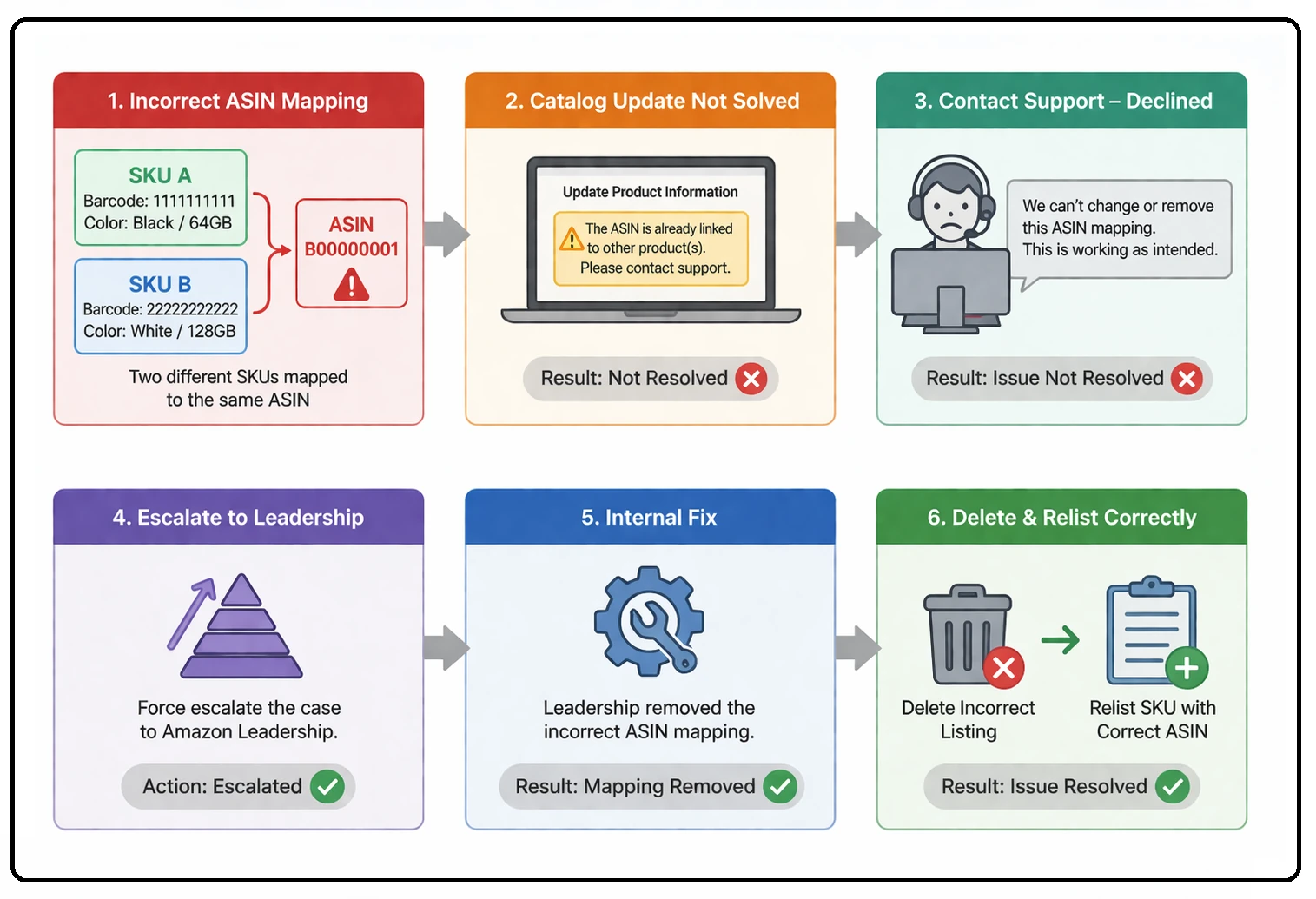
Two distinct SKUs with different barcodes and product data were merged under a single ASIN.

Reliable Remote Staffing
Since 2004
Client success story · CS22
A catalogue error driving returns, warnings and deactivation risk
A single ASIN was incorrectly linked to two SKUs, so customers received the wrong product. Return rates climbed, customer dissatisfaction grew, and both revenue and operational stability were affected.
As returns rose, Amazon issued a performance warning and the account faced potential deactivation. Multiple internal attempts had failed against catalogue-level conflicts.
Problem
The objective was to find the root cause, correct the mapping, and align each SKU to the right ASIN — restoring accurate order processing and stabilising account health before the warning became a deactivation.
Two distinct SKUs with different barcodes and product data were merged under a single ASIN.
The mapping kept reverting despite repeated update attempts.
Wrong fulfilment drove returns up and triggered account warnings.
File uploads and manual updates could not override the backend conflict.
SKUs remapped incorrectly even after the listings were recreated.
Repeated case rejections slowed resolution.
Reserved inventory blocked direct correction, requiring backend intervention.
Solution
SKU–ASIN relationships were analysed to identify the root cause and the conflicts holding it in place.
Inventory uploads, backend edits and listing updates were each tested to establish what the constraint actually was.
Support cases were followed up persistently and escalated rather than refiled.
Escalation to Amazon leadership confirmed the reserved inventory issue that was blocking every direct correction.
Internal removal of the incorrect catalogue constraints was enabled.
SKU data was reset to clear the conflicting values.
Listings were recreated with the correct ASIN mapping, coordinated with support so the fix held.
Impact
Some catalogue problems cannot be fixed from the surface. When uploads, edits and relisting all revert, the constraint is upstream — and the only route is persistent, evidenced escalation until someone with backend access can remove it.
Describe it in a sentence. We will tell you what we would do about it, and whether it is something we should be doing at all.
Tell us the workload
We will map the roles, the hours and the cost, and come back within one working day.
Or submit an enquiry — the full form, with a service line