
Client success story · CS14
Andon Cord reinstatement for a high-risk ASIN
A 26.67% return rate traced to expectation, not defect
- PlatformAmazon Vendor Central
- SectorUS wellness brand
- Issue typeAndon Cord / high return rate
- Return rate at flag26.67%
- 26.67%return rate that triggered the flag
- 1ASIN reinstated
- Resumedpurchase orders after reinstatement
Client background
A US wellness brand came to us at a critical moment: a key ASIN was at risk. The product had been performing steadily and contributing to regular purchase orders when it came under scrutiny for an unusually high return rate.
What looked like a product performance issue was a business risk — the listing was flagged, visibility was restricted, and ongoing purchase orders were in question. The job was to recover the ASIN and to understand what had gone wrong underneath it.
Problem
Operational challenges
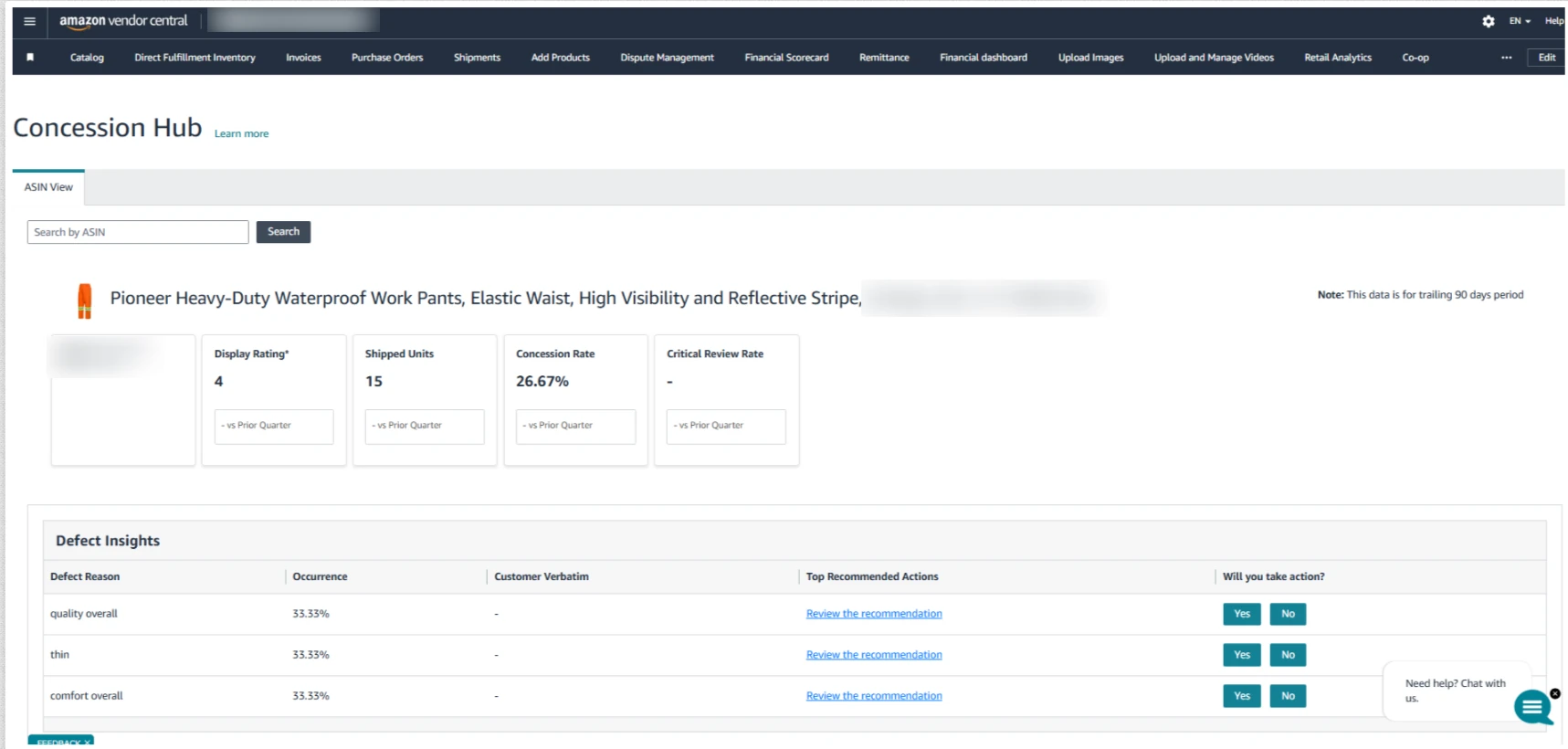
The ASIN was flagged under Amazon's monitoring system for a return rate of 26.67%, well above acceptable thresholds. That was not just a metric — it started a chain reaction: visibility restrictions on the listing, purchase orders at risk of being paused, inventory potentially returned or liquidated, and weakening account health signals.
Speed and accuracy both mattered. Acting without understanding the cause risked rejection or further escalation.
Solution
Custom solution executed
-
01
Understanding the real problem
Rather than assuming, the work started with data: Concessions Hub insights, customer feedback and Voice of the Customer reports.
The issue was not a defect. It was a gap between customer expectation and product perception. Three themes recurred — customers felt the material was thinner than expected, comfort did not match expectations, and perceived quality did not match what the listing implied. That shifted the entire approach: the problem was not what the product was, but how it was presented.
-
02
Rebuilding the product narrative
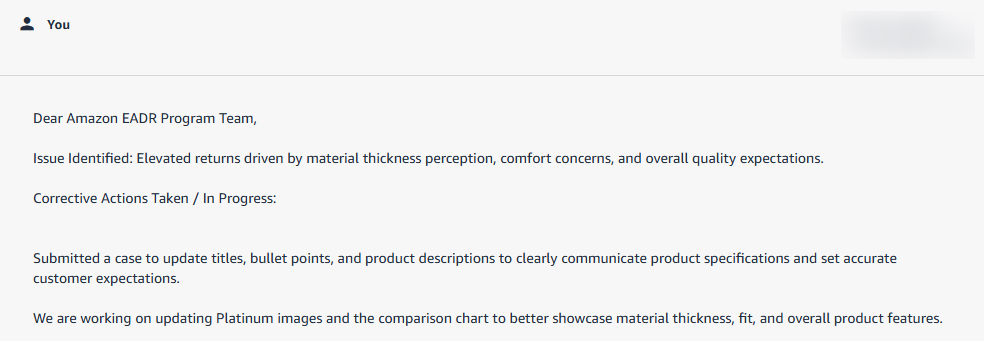
Product content was reworked to describe the product accurately. Titles were refined to remove ambiguity, bullets rewritten to explain material, usage and comfort level plainly, and descriptions adjusted to set the right expectation before purchase — so a customer reading the listing knows what they are buying.
-
03
Improving visual clarity
Comparison charts were introduced and upgraded A+ modules planned, because in categories where feel and comfort cannot be experienced physically, visuals carry what words cannot. Images were aligned to actual product representation to remove room for misinterpretation.
-
04
Validating every detail
A complete detail page audit followed: size charts verified, backend attributes cross-checked, product data aligned with actual specifications.
- 05
-
06
Managing communication with Amazon
The case was actively managed: responses to Amazon's queries, consistent follow-up, and every reply aligned to the data and the improvements already made.
Impact
Business value delivered
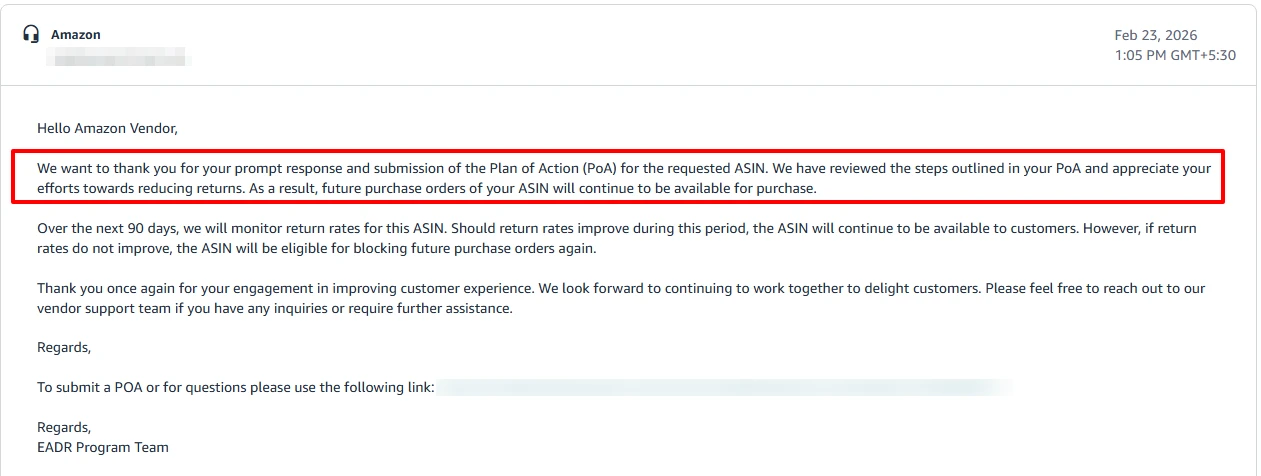
- The ASIN was reinstated
- Purchase orders resumed
- Listing stability regained
- Customer expectations aligned with actual product experience
- Return risk significantly reduced
- Listing clarity improved across all touchpoints
What it changed for the client
- A high-risk listing turned into a stable, scalable one
- A detail page stronger than before the flag — clearer and more accurate
- Renewed client confidence in marketplace operations
In short
High return rates are frequently not a defect problem but a communication one. Reading the returns data before writing the appeal is what turned this from a reinstatement argument into a listing that stopped generating returns.
Services this story used
Related case studies
Have a version of this problem?
Describe it in a sentence. We will tell you what we would do about it, and whether it is something we should be doing at all.