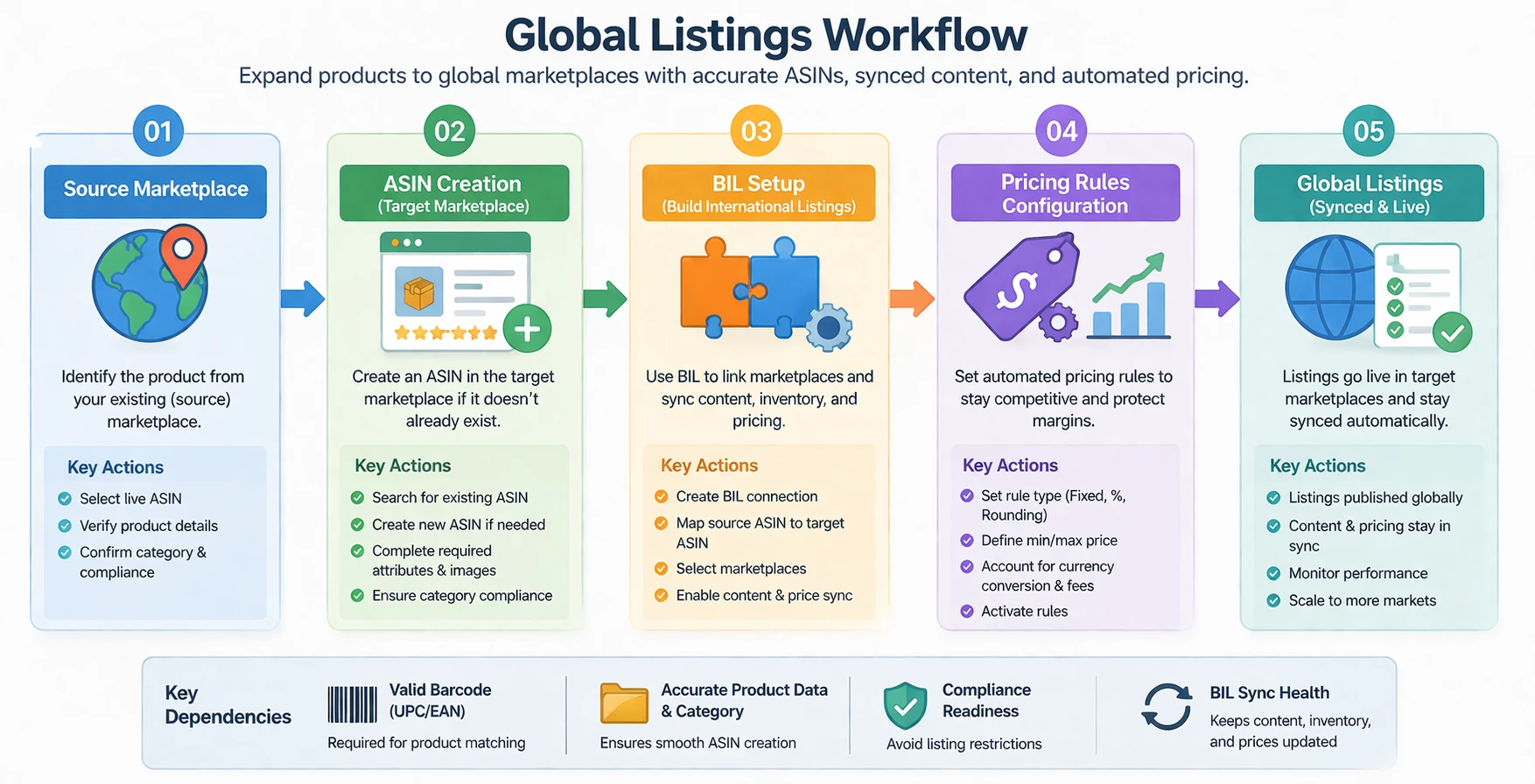
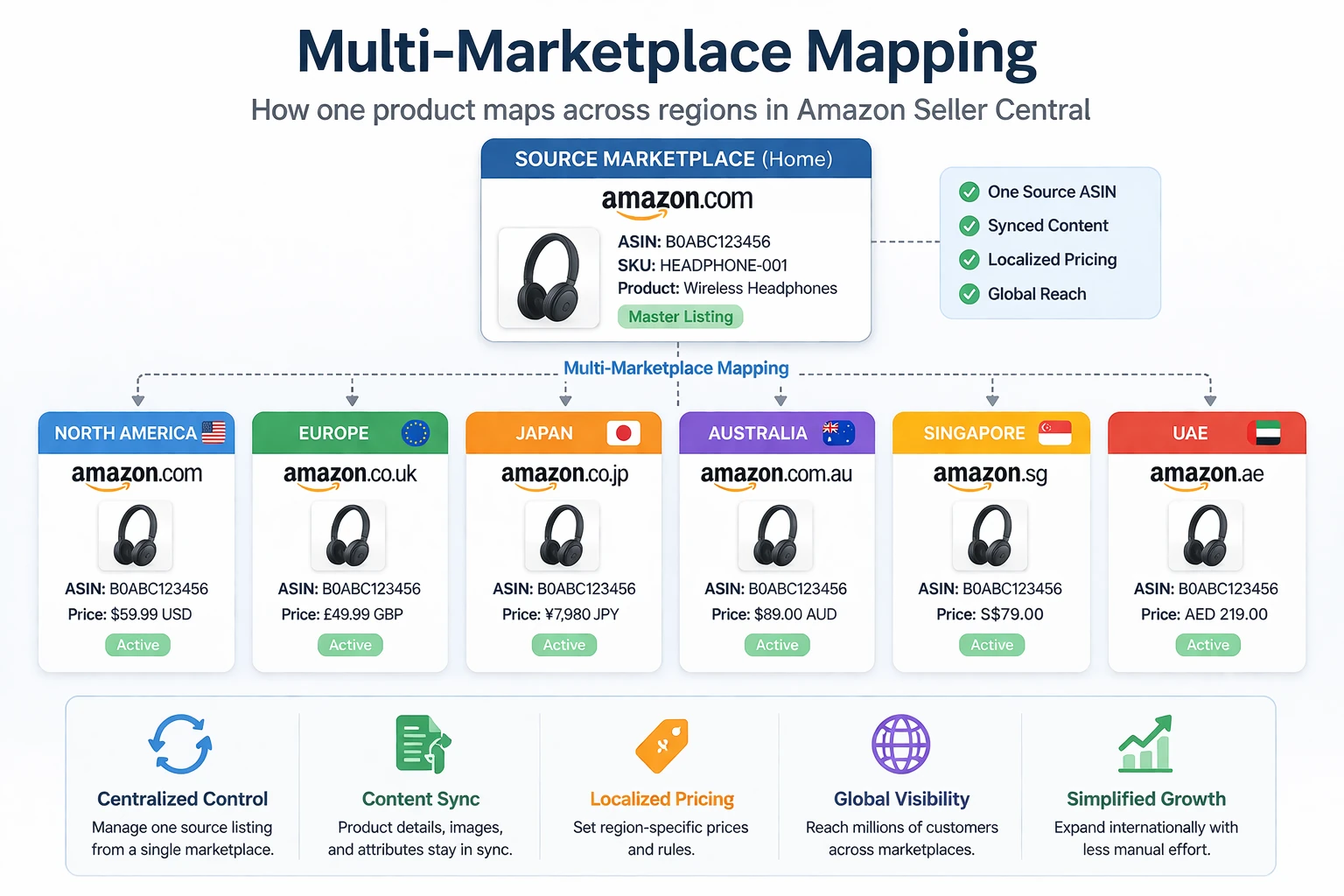
ASINs missing in target marketplaces
Many products did not exist in the destination marketplace, requiring new ASIN creation with accurate data and no duplication.

Reliable Remote Staffing
Since 2004
Client success story · CS25
Marketplace activation, ASIN creation and pricing across regions
The client wanted to expand into multiple international Amazon marketplaces to open new revenue streams. The brand had a stable presence in its primary marketplace but no operational framework for scaling globally.
Expansion meant more than replicating listings: marketplace activation, ASIN creation in destination marketplaces, pricing strategy alignment and catalogue compatibility across regions. Without structure, the risks were listing errors, pricing inconsistency and poor discoverability.
Problem
Multi-marketplace expansion exposes every assumption in a catalogue at once.
Many products did not exist in the destination marketplace, requiring new ASIN creation with accurate data and no duplication.
Different marketplace requirements produced data mismatches and listing errors.
Build International Listings missed key attributes, requiring manual correction.
Conversion, fees and competitiveness had to be managed without losing margin.
Incorrect parent-child mapping across regions risked broken listings.
Existing ASINs in the destination marketplace conflicted with imported data.
Each marketplace brought its own rules, adding listing complexity.
Solution
Every target marketplace configured for listing operations before any product data moved.
Missing ASINs created with complete, structured data rather than partial replication.
Build International Listings set up with control mechanisms allowing regional attribute overrides where replication is not appropriate.
Pricing automated to handle currency conversion and regional cost while protecting margin.
Product data aligned to each region's requirements and conventions.
A validation framework ensuring parent-child and SKU mapping stayed accurate across marketplaces.
Listings monitored after launch and issues resolved as regions went live.
Impact
International expansion fails on the details — a missing attribute, a currency rule, a broken variation family. Treating it as a catalogue project rather than a replication exercise is what makes the second marketplace easier than the first.
Describe it in a sentence. We will tell you what we would do about it, and whether it is something we should be doing at all.
Tell us the workload
We will map the roles, the hours and the cost, and come back within one working day.
Or submit an enquiry — the full form, with a service line